

Your resume may never reach a human recruiter. In Australia, over 75% of recruiters now use AI-powered tools to screen candidates before a person ever reads a single line. That means your carefully written resume could be filtered out in seconds, not because you lack the skills, but because the formatting or keywords don't match what the system expects. This guide breaks down exactly how AI resume writing tools work, what results you can realistically expect, which tools suit Australian job seekers, and how to avoid the traps that catch most applicants off guard.
Table of Contents
- What is AI resume writing, and why does it matter in Australia?
- How do AI resume writing tools work?
- Benefits of using AI for your resume and the results to expect
- Pitfalls to avoid: Common limitations and warnings
- How to get the most from AI resume writers: Actionable tips
- The real secret: Why blending AI with human touch makes all the difference
- Ready to boost your Australian job search with AI?
- Frequently asked questions
Key Takeaways
| Point | Details |
|---|---|
| AI boosts resume visibility | AI-written resumes are much more likely to pass automated screening and reach recruiters. |
| Australian customization matters | Always localize content for Australian tone and job market expectations for better results. |
| Blend AI and human editing | The most effective resumes use AI for structure but keep your real voice and achievements. |
| Know the pitfalls | Avoid relying solely on AI—watch out for subscription traps and impersonal language. |
What is AI resume writing, and why does it matter in Australia?
AI resume writing uses artificial intelligence to help you create, optimize, and tailor your resume for specific job applications. It is not just spell-checking or formatting. These tools use technologies like natural language processing (NLP), which is the ability of a computer to read and interpret human language, and machine learning to analyze job descriptions, identify critical keywords, and restructure your content to match what employers and their systems are looking for.
At the center of this process is the Applicant Tracking System, or ATS. An ATS is software used by employers to automatically sort, rank, and filter incoming resumes before a recruiter sees them. If your resume does not contain the right keywords or is formatted in a way the ATS cannot read, it gets rejected automatically. You never hear back, and you never know why.

This is a real and growing problem in Australia. Over 75% of Australian recruiters use AI hiring tools as part of their screening process. That number is only increasing as hiring volumes grow and companies look for faster ways to manage applications.
Who benefits most from AI resume writing tools?
- Recent graduates who lack extensive work history and need to present transferable skills clearly
- Professionals re-entering the workforce after a career break, parental leave, or time abroad
- Career changers moving into a new industry who need to reframe existing experience
- Anyone applying to multiple roles who needs to tailor their resume quickly and efficiently
The good news is that AI resumes for Australia are now more accessible than ever, and using the right tools can dramatically improve your chances of getting shortlisted.
Key stat: 72% of resumes are rejected by ATS systems before a human ever reads them. Getting past that filter is the first and most critical step.
How do AI resume writing tools work?
Understanding the process behind these tools removes the mystery and helps you use them more effectively. Here is what typically happens when you use an AI resume writing tool.
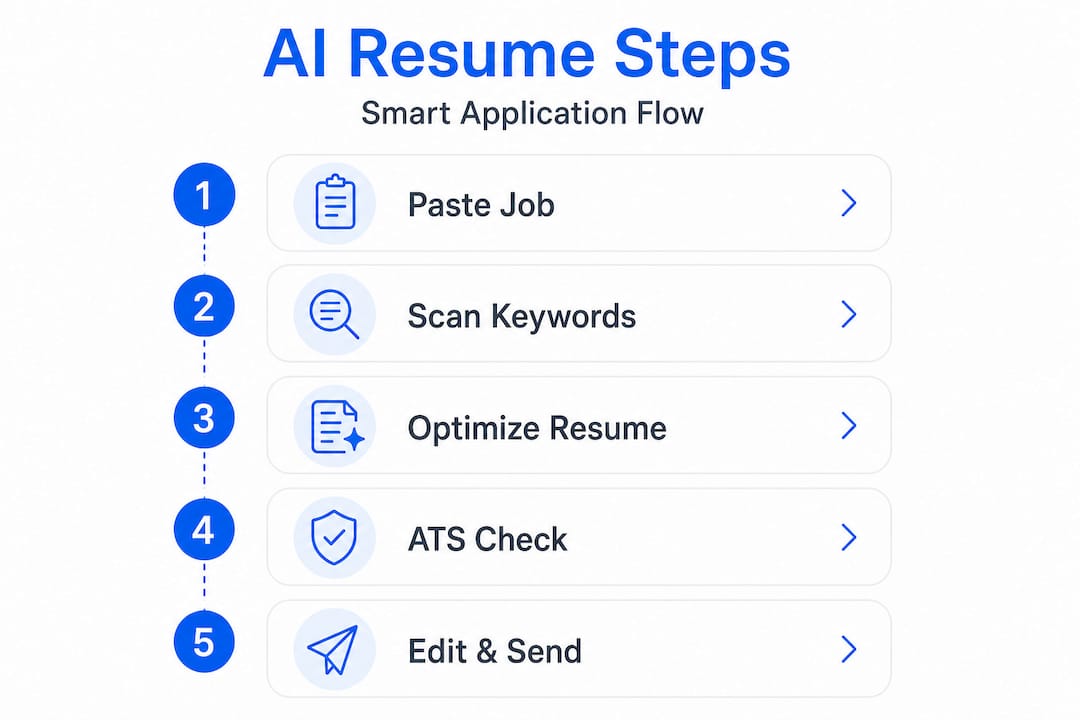
- You input your information. You either upload an existing resume or fill in your work history, skills, education, and contact details. Most tools accept plain text or PDF uploads.
- You paste or upload the job description. This is the most important step. The AI compares your content against the specific language used in the job posting.
- The AI scans for keyword alignment. It identifies which keywords, phrases, and skills appear in the job description but are missing or underrepresented in your resume.
- The tool scores your resume. Many platforms give you an ATS compatibility score in real time, showing you exactly where you are losing points.
- You receive optimization suggestions. The AI recommends edits: adding missing keywords, restructuring bullet points, adjusting section headings, or reformatting dates.
- You review, edit, and export. The final resume is yours to refine before submitting.
Pro Tip: Always paste the actual job description into the tool, not just the job title. The AI needs the full text to match your resume accurately to what that specific employer is looking for.
When comparing tools available to Australian job seekers, it helps to understand what each one does well. Popular tools in Australia include Resume Now, MyPerfectResume, Kickresume, Rezi, Jobscan, and Novoresume. Novoresume is particularly well-suited for recent graduates because it offers a free one-page option. Jobscan specializes in ATS keyword matching and is a strong choice for professionals re-entering the workforce who need fast, accurate tailoring.
| Tool | Best for | Key feature | Free option |
|---|---|---|---|
| Novoresume | Graduates | Clean one-page templates | Yes (one page) |
| Jobscan | ATS optimization | Keyword match scoring | Limited |
| Kickresume | Visual design | AI content suggestions | Yes (limited) |
| Rezi | ATS-focused resumes | Real-time ATS scoring | Yes (basic) |
| Resume Now | Quick resume building | Step-by-step wizard | Yes (basic) |
For Australian resume adaptation, look for tools that allow you to customize section headings and tone, since Australian employers have specific expectations around formatting and language that differ from US or UK norms.
Benefits of using AI for your resume and the results to expect
Does AI resume writing actually work? The data says yes, and the improvements can be significant.
According to empirical research, 72% of resumes are rejected by ATS systems before optimization. After using AI tools, 85% of users improved their ATS score by 30 or more points. Perhaps most importantly, 60% of users landed interviews within two weeks of optimizing their resumes.
"After optimizing my resume with an AI tool, I went from zero callbacks in three weeks to two interview requests in four days." This kind of result is not unusual when the right keywords are finally in the right places.
Specific benefits for Australian job seekers:
- Faster turnaround. You can tailor a resume to a specific job in under 30 minutes rather than starting from scratch each time.
- Consistency. AI tools ensure your formatting stays clean and professional, which matters for ATS readability.
- Keyword coverage. You stop guessing which terms recruiters are searching for and start matching them precisely.
- Confidence for career returners. If you have been out of the workforce for a few years, AI tools help you reframe your experience in language that resonates with current hiring standards.
- Leveling the playing field. You do not need to pay for an expensive professional resume writer to get an ATS-optimized document.
| Before AI optimization | After AI optimization |
|---|---|
| 72% rejected by ATS | 85% improved score by 30+ points |
| Low keyword match | High keyword alignment |
| Generic formatting | ATS-compatible structure |
| Weeks without callbacks | 60% got interviews within 2 weeks |
For interview success insights, the data consistently shows that getting past the ATS filter is the single biggest lever you can pull in your job search. AI tools are currently the most efficient way to do that.
Pitfalls to avoid: Common limitations and warnings
No tool is perfect. Knowing where AI resume writers fall short helps you use them smarter and avoid costly mistakes.
Watch out for these common issues:
- Complex formatting fails. AI resume tools often struggle with resumes that use tables, columns, text boxes, or graphics. ATS systems may not be able to parse this content at all, which means your information disappears entirely.
- Generic or robotic content. AI-generated text can sound flat and impersonal. Phrases like "results-driven professional with a proven track record" are overused and add no real value to your application.
- Loss of Australian tone. Australian workplace culture values directness, humility, and authenticity. AI tools trained on US or UK data may produce language that feels out of place to local recruiters.
- AI hallucinations. This is when an AI confidently generates false information, such as incorrect job titles, fabricated dates, or skills you never mentioned. Always fact-check every line of AI-generated content.
- Subscription traps. Many tools offer a free trial but lock your completed resume behind a paywall when you try to download it. Read the pricing terms before you invest time in building your resume on any platform.
- AI detection risks. Some employers now use AI detection tools to flag resumes that appear fully machine-generated. A resume that reads like it was written by a robot can hurt your application.
Pro Tip: Run your AI-generated resume through a plain-text test before submitting. Copy and paste the content into a basic text editor. If the layout falls apart or sections disappear, an ATS will likely have the same problem.
For Australian resume advice, always treat AI output as a first draft, not a finished product. The tool does the heavy lifting, but you need to bring the authenticity.
How to get the most from AI resume writers: Actionable tips
With the pitfalls covered, here is how to turn AI's potential into a real job search advantage.
- Start with a clean, simple format. Before uploading your resume, remove tables, columns, and graphics. Use a single-column layout with standard section headings like Work Experience, Education, and Skills.
- Paste the full job description every time. Do not reuse a generic optimized resume across multiple applications. Each job description contains unique keywords that the AI needs to match against your content.
- Edit for Australian tone immediately. After the AI generates your resume, read it aloud. Does it sound like you? Does it reflect how Australians actually communicate in professional settings? Adjust any phrases that feel stiff or overly formal.
- Add specific, quantified achievements. AI tools often produce vague bullet points. Replace them with concrete results: "Managed a team of six and reduced project delivery time by 20%" is far stronger than "Demonstrated leadership skills."
- Cross-check the keyword match manually. After the AI optimization, read the job description one more time and confirm that your resume addresses the key requirements directly. Do not rely solely on the AI's score.
- Check for factual accuracy. Review every date, job title, company name, and skill claim. AI tools can introduce errors, especially if your original resume had any inconsistencies.
- Monitor subscription costs. Set a calendar reminder to review any free trials you sign up for. Many platforms auto-renew at a monthly rate after the trial period ends.
Human editing for authenticity is not optional. It is the step that separates a resume that gets filed away from one that gets a callback.
For using AI resume tools effectively, think of the AI as your research assistant and first-draft writer. You are the editor, the storyteller, and the person who knows your career better than any algorithm ever will.
The real secret: Why blending AI with human touch makes all the difference
Here is something most articles about AI resume writing will not tell you: the job seekers who get the best results are not the ones who fully automate the process. They are the ones who treat AI as a starting point, not a finish line.
There is a widespread assumption that if you use the right AI tool and hit a high ATS score, the job is done. That thinking leads to a very specific kind of failure. Your resume passes the filter, a recruiter opens it, and it reads like every other AI-optimized document they have seen that day. Nothing stands out. No one calls.
The Australian job market rewards authenticity in a way that is easy to underestimate. Recruiters here are attuned to language that feels genuine versus language that feels manufactured. When a resume is entirely AI-generated, experienced hiring managers often sense it, even if they cannot explain exactly why.
The winning approach is to use AI for structure, keyword alignment, and ATS compatibility, then layer in your real voice. Share a specific project outcome. Mention a challenge you navigated. Use the language you would actually use in an interview. That combination is what makes a resume both machine-readable and human-compelling.
The other mistake we see constantly is applying the same optimized resume to every job. AI tools make it easy to tailor quickly. Use that capability. A resume that is 90% matched to a specific job description will always outperform a generic one, no matter how polished it looks.
The AI and personal touch combination is not a compromise. It is the strategy that actually works.
Ready to boost your Australian job search with AI?
You now understand how AI resume writing works, what results it delivers, and how to avoid the traps. The next step is putting it into practice with tools built specifically for the Australian job market.
OzHire AI for Australians offers a full suite of AI-powered tools designed around Australian employer expectations and ATS requirements. You can generate an optimized resume, write a tailored cover letter, run a Job Match Optimizer to align your resume with a specific role, and check your ATS compliance score, all in one place. No credit card is required to get started, and results take as little as 30 seconds. If you are serious about landing your next role faster, this is where to start.
Frequently asked questions
Are AI resume writers better than human resume writers?
AI resume writers are fast and ATS-friendly but still need human editing for authenticity, especially in Australia where local tone and cultural fit matter to recruiters.
Will using AI tools help me land a job interview faster?
Yes, 60% of users landed interviews within two weeks after optimizing their resumes with AI tools, making it one of the most effective ways to accelerate your job search.
What Australian AI resume tools are recommended?
Popular tools in Australia include Resume Now, MyPerfectResume, Kickresume, Rezi, Jobscan, and Novoresume, each suited to different needs from graduate applications to ATS-focused optimization.
What risks are there with AI-written resumes?
Risks include generic text, lost local tone, and subscription traps; always review and edit AI output carefully before submitting to ensure your resume sounds authentic and accurate.