

You send out application after application, and nothing comes back. No call. No email. Just silence. That frustration is real, and you're not alone. Many Australian job seekers, from fresh graduates to professionals returning after a career break, are discovering that even strong experience gets overlooked when a resume isn't built to pass modern screening systems. Official Australian guidance recommends tailoring your resume by highlighting relevant experience, using language from the job description and application kit, and showing measurable achievements. AI tools can help you do exactly that, faster and more precisely, but only when you use them the right way.
Table of Contents
- What you need before using AI for your resume
- Step-by-step: Using AI to build and tailor your resume
- ATS and recruiter readiness: Mistakes to avoid with AI resumes
- Verifying and improving your AI-enhanced resume
- Why mastering AI resumes in Australia means going beyond keywords
- Get started with smarter AI resumes for Australian jobs
- Frequently asked questions
Key Takeaways
| Point | Details |
|---|---|
| Start with the job ad | Analyze each job advertisement and match your resume content using authentic, evidence-backed language. |
| Use AI as a tool | Let AI speed up drafting and tailoring but always review and verify every detail for accuracy. |
| Avoid over-optimization | Do not stuff irrelevant keywords—focus on true experiences that fit Australian ATS and recruiter expectations. |
| Verify results | Leverage feedback tools and manual checks to ensure your resume passes ATS and convinces real decision makers. |
What you need before using AI for your resume
Let's start with what you need in hand before you even touch an AI resume tool.
Most people jump straight into an AI tool and expect magic. The reality is that AI is only as good as the input you give it. If you feed it vague, outdated, or incomplete information, you'll get a polished but hollow resume. That won't get you interviews.
Start by gathering your core career data. This means collecting every job you've held, including exact start and end dates, official job titles, key responsibilities, and, most importantly, measurable results. Think numbers: "reduced processing time by 30%," "managed a team of 8," or "increased client retention by 15%." These specifics are what separate a forgettable resume from one that gets shortlisted.
Next, read the job ad carefully. Not just once. Read it twice. Identify the top five to seven requirements the employer is asking for. Look for repeated words and phrases. In Australia, many employers also release an application kit or selection criteria document alongside the job ad. That document is gold. It tells you exactly what language to use and what evidence to provide.
Here's what to collect before you start:
- Your full employment history with exact dates and titles
- A list of measurable achievements for each role
- The job advertisement and any application kit or selection criteria
- Keywords and phrases repeated in the job ad
- Any certifications, qualifications, or licenses relevant to the role
- Contact details and references ready to go
Understand what ATS and recruiters are actually looking for. ATS stands for Applicant Tracking System, a software tool that many Australian employers use to manage large volumes of applications. It scans resumes for relevance, keywords, and structure. Recruiters then review what the ATS surfaces. Both want the same thing: a clear, relevant match between your experience and the role. Relevance beats recency. A role from five years ago that directly matches the job description will outperform a recent role that doesn't.
| Preparation step | Why it matters |
|---|---|
| Collect employment data with dates | AI needs accurate inputs to generate accurate outputs |
| Identify job ad keywords | Helps align your resume language to ATS filters |
| Review application kit | Reveals exact evidence and language employers expect |
| List measurable achievements | Transforms duties into results that stand out |
| Check for required qualifications | Ensures you don't miss mandatory criteria |
Pro Tip: When customizing your resume for each role, copy the exact phrases from the job ad into your notes. Then check whether your AI-generated resume actually uses those phrases in context, not just as a list of skills at the bottom.
Step-by-step: Using AI to build and tailor your resume
With your prep complete, here's how to use AI step by step, without falling into common traps.
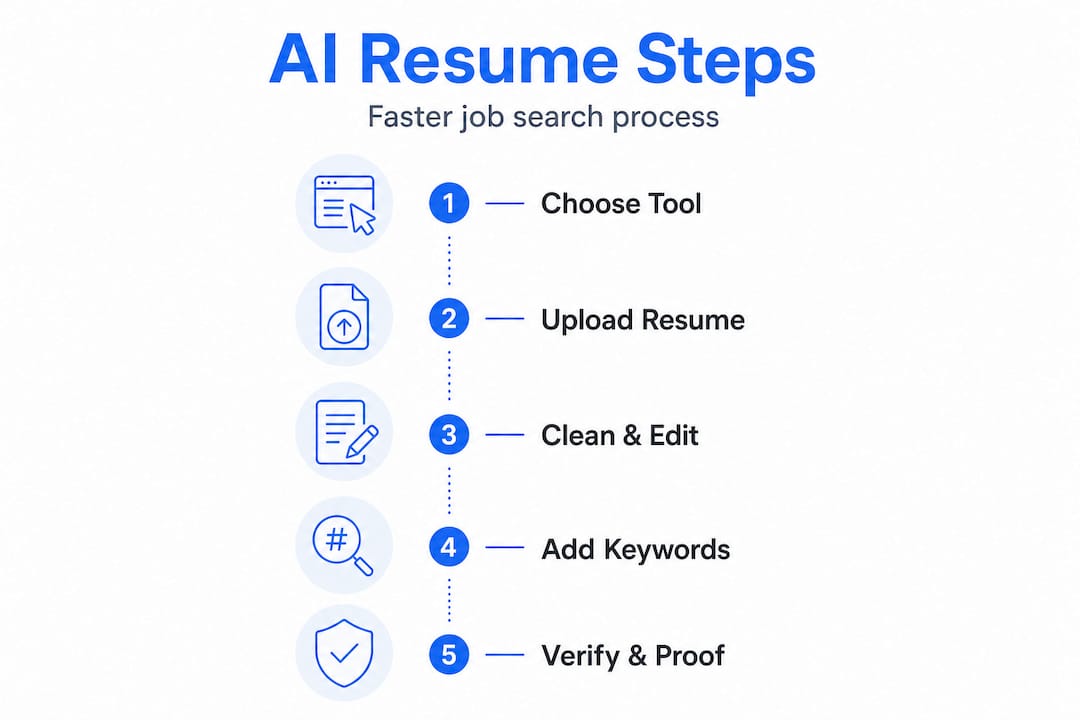
Step 1: Choose a reputable AI resume tool. Look for a platform built specifically for Australian job seekers. Generic tools often miss local nuances, like the preference for two to three page resumes in Australia, the importance of a professional summary over an objective statement, and the expectation of a referee section. An AI-powered resume builder designed for the Australian market will already account for these standards.
Step 2: Upload or draft your base resume. If you already have a resume, upload it. If you're starting from scratch, input your career data directly. At this stage, you're creating the foundation. Don't worry about perfection yet.
Step 3: Use AI to clean and reformat, not to invent. This is critical. AI is excellent at improving sentence structure, removing redundancy, and reformatting content for readability. It is not a tool to fabricate experience. Every bullet point, every achievement, every skill listed must reflect something real. AI resume approaches work best as an editor and workflow tool rather than as a source of unverifiable career claims.

Step 4: Feed in the job ad keywords. Most AI resume tools allow you to paste in a job description. The tool then identifies gaps between your current resume and the role requirements. Use this feature to align your language. If the job ad says "stakeholder engagement" and your resume says "client communication," the AI can help you bridge that gap, as long as the experience genuinely matches.
Step 5: Verify every AI suggestion against your real experience. Read every change the AI makes. Ask yourself: "Is this true? Can I back this up in an interview?" If the answer is no, remove it or rewrite it. Your resume is a document you'll be asked to defend in person.
Step 6: Use university AI feedback tools if you're a graduate. The University of Melbourne's SMART Resume system is one example of an AI-enabled resume feedback platform that scores your resume and gives targeted suggestions. Many Australian universities offer similar tools. These are especially useful for recent graduates who may not have worked with a careers advisor before.
Step 7: Proofread for context, accuracy, and tone. Run a final check. Read it aloud. Does it sound like you? Does every claim have evidence behind it? Is the formatting consistent? These final checks take ten minutes but can make a significant difference.
| AI resume approach | Best for | Risk level |
|---|---|---|
| AI as editor (refine your own content) | All job seekers | Low |
| AI as keyword aligner (match job ad language) | Mid-career professionals | Low to medium |
| AI as full drafter (generate from scratch) | Graduates with limited experience | Medium to high |
| AI as fabricator (invent experience) | No one | Very high |
Pro Tip: After using AI to tailor your resume, read only the bullet points in your experience section. Each one should answer the question: "What did I do, and what was the result?" If any bullet point is vague or generic, it needs to be rewritten with a specific example.
ATS and recruiter readiness: Mistakes to avoid with AI resumes
Now that you know what to do, here's what NOT to do when using AI for your resume.
Don't let AI overwrite your real experience. This is the most common mistake. You ask AI to "improve" your resume, and it returns something that sounds impressive but no longer reflects what you actually did. Always compare the AI output to your original notes. If something has been added or changed significantly, verify it before keeping it.
Don't stuff your resume with irrelevant keywords. It's tempting to load up on keywords in hopes of passing ATS filters. But recruiters notice when a resume reads like a keyword list rather than a career story. Worse, if you get to the interview stage and can't speak to those keywords, you'll lose credibility fast.
Understand what ATS actually does. There's a widespread myth that ATS systems automatically reject most resumes. Research shows that ATS rarely auto-rejects resumes based purely on formatting or keyword scores, and that auto-rejection is less common than most people think. Most resumes are still reviewed by a human at some point. This means your goal is not to "trick" the ATS but to make your resume easy to read for both the software and the person behind it.
Be aware of the accuracy crisis in AI-generated resumes. Australian employers are paying attention. Hiring data from Australian firms shows that a high proportion of AI-generated resumes contain inaccuracies, and this is increasing the screening load for hiring managers. In fact, 83% of employers have found false information in AI-generated resumes. This creates distrust, and it's hurting job seekers who use AI carelessly.
"The goal of enhancing resume quality with AI is to make your real experience shine more clearly, not to replace it with something that sounds better but isn't true."
Here are the key mistakes to avoid:
- Accepting every AI suggestion without checking it against your actual experience
- Using keywords that appear in the job ad but don't reflect your genuine skills
- Assuming ATS will reject you for minor formatting issues
- Submitting an AI-generated resume without a thorough human review
- Exaggerating titles, responsibilities, or results beyond what you can verify
- Ignoring the application kit or selection criteria for structured roles
For Australian Public Service roles specifically, accuracy is non-negotiable. These applications are assessed against formal selection criteria, and your resume is treated as a set of claims that must be substantiated. Any inconsistency between your resume and your interview responses will be noticed immediately.
Verifying and improving your AI-enhanced resume
Here are the quality control steps you shouldn't skip for a truly interview-winning resume.
Step 1: Fact-check every detail. Go line by line. Confirm your job titles, employment dates, and reported achievements. If your resume says you "led a project that delivered $500K in savings," make sure you can explain exactly how that happened in an interview.
Step 2: Match keywords to real evidence. For every keyword you've included, ask yourself: "Where in my experience does this appear?" If you can't point to a specific role or project, remove the keyword. This is especially important for APS applications, where resumes are assessed as claims and your evidence must align precisely with the language of the job advertisement.
Step 3: Use a live scoring tool. Platforms like the University of Melbourne's SMART Resume provide color-coded feedback showing which sections of your resume are strong (green), need improvement (yellow), or are missing (red). This kind of instant feedback helps you prioritize what to fix before you submit.
Step 4: Iterate for each application. Don't submit the same resume to every job. Use your AI tool to create a tailored version for each role. This takes less time than you think, especially once you have a strong base resume. Ten minutes of tailoring per application can dramatically improve your response rate.
Step 5: Address employment gaps proactively. If you have a gap in your employment history, don't hide it. A brief, honest explanation in your resume or cover letter removes doubt. Whether it was caregiving, study, travel, or health, employers respond better to transparency than to unexplained gaps.
| Quality check | What to look for | Action if it fails |
|---|---|---|
| Date accuracy | Correct start and end dates for all roles | Fix immediately |
| Keyword relevance | Keywords match genuine experience | Remove or replace with accurate terms |
| Achievement specificity | Results are quantified and verifiable | Add numbers or reframe as a task |
| ATS compliance score | Green rating in scoring tool | Revise flagged sections |
| Employment gap explanation | Gaps are addressed clearly | Add a brief note in the resume or cover letter |
Pro Tip: After final resume checks, ask a trusted friend or colleague to read your resume cold. If they can't tell what role you're targeting within 10 seconds, your summary section needs work.
Why mastering AI resumes in Australia means going beyond keywords
Here's a view that most articles won't give you: keyword matching alone will not get you hired. It might get you past the first filter. But Australian recruiters, especially in government, healthcare, and education sectors, are trained to look for evidence, not just language.
The best practice for landing a job faster with AI is to keep it as a drafting and editing assistant while ensuring every keyword you include is genuinely evidenced by your experience and mirrors the job ad terminology. That's the standard. Not keyword stuffing. Not AI-generated fiction. Genuine alignment between what the job requires and what you have actually done.
We've seen this play out repeatedly. Job seekers who use AI-assisted resume strategies as a starting point and then layer in their own career stories consistently outperform those who submit raw AI output. The reason is simple: authenticity reads differently. Recruiters can tell when a resume sounds like a person and when it sounds like a template.
The uncomfortable truth is that AI gives everyone access to polished language. That means polished language alone is no longer a differentiator. What sets you apart now is the quality and specificity of your evidence. A well-structured resume that clearly connects your real experience to the role requirements will always outperform a keyword-heavy document with nothing to back it up.
Use AI to work faster. Use your judgment to work smarter.
Get started with smarter AI resumes for Australian jobs
Ready to put these strategies to work? Here's how you can get started right now.
OzHire AI is built specifically for Australian job seekers. Whether you're a recent graduate applying for your first professional role or a seasoned professional returning to the workforce, the platform helps you build and tailor your resume to meet Australian ATS standards quickly and accurately.
The OzHire AI automated resume builder gives you Australian-specific templates, a Job Match Optimizer that rewrites your resume for keyword alignment, and a Resume Scorer that shows your ATS compliance in real time. You can generate and refine your resume in under 30 seconds, with no credit card required. Stop guessing what employers want. Start submitting resumes that are built to get noticed.
Frequently asked questions
How does AI help tailor my resume for Australian jobs?
AI resume tools quickly align your experience with job descriptions by identifying keyword gaps and suggesting language improvements, but AI works best as an editor rather than a source of unverifiable claims, so every detail must reflect your real experience.
Will ATS software in Australia auto-reject my resume if I miss keywords or use the wrong format?
Auto-rejection by ATS is uncommon in Australia, and research debunks the 75% myth that most resumes are filtered out automatically. Most applications are still reviewed by a human recruiter at some stage.
Are AI-generated resumes safe to use for government roles?
AI can help structure and keyword-match your resume for public service applications, but APS resumes are assessed as claims against selection criteria, so every example you include must be fully accurate and directly supported by your experience.
How do I prevent mistakes or false information in my AI-generated resume?
Always fact-check every detail after using AI, and remember that Australian firms report high rates of inaccuracies in AI-generated resumes, which damages your credibility with employers. Keep your content honest, specific, and verifiable.