

Australian recruiters are under pressure like never before. Application volumes are climbing, hiring managers want faster turnarounds, and the expectation to find quality candidates quickly is relentless. AI tools promise relief, but with so many options flooding the market, it's hard to know which ones actually deliver real productivity gains versus which ones just add another layer of complexity to your workflow. This guide cuts through the noise with evidence-based, practical strategies that Australian recruitment agencies and professionals are using right now to work smarter, fill roles faster, and spend more time on the work that actually requires human judgment.
Table of Contents
- Key criteria for evaluating AI productivity tools
- Top AI-powered ways to boost recruiter productivity
- How AI impacts recruiter metrics: measurable outcomes and risks
- Ensuring ROI: best practices for piloting and benchmarking AI tools
- AI for recruiters: what actually works and why the hype can be dangerous
- Supercharge your recruiting workflow with OzHire AI
- Frequently asked questions
Key Takeaways
| Point | Details |
|---|---|
| AI automates repetitive recruiting tasks | Processes like resume parsing and job posting are efficiently handled by AI, letting recruiters focus on higher-value work. |
| ROI requires disciplined piloting | To ensure actual value, agencies should baseline metrics and run small-scale pilots before investing in AI tools. |
| Oversight prevents new risks | AI can introduce low-quality or fake applicants, so human review and structured pipelines are essential. |
| Pipeline metrics show real gains | Look for reductions in time-to-fill, recruiter workload, and improved candidate experience as proof of AI's impact. |
Key criteria for evaluating AI productivity tools
Not every AI tool is built the same, and not every one will fit your workflow. Before you invest time or budget in a new platform, you need a clear framework for evaluation. According to research on AI sourcing and parsing, the mechanics that genuinely improve recruiter productivity fall into four core categories.
Here's what to look for:
- Structured extraction and deduplication. The tool should convert unstructured resume data into clean, searchable fields automatically. It should also flag or remove duplicate candidate profiles so your database stays accurate and usable.
- Automated triage. Good AI filters out obvious mismatches before they reach your desk. This alone can save hours each week, especially during high-volume campaigns where hundreds of applications come in for a single role.
- Automated communications and scheduling. Repetitive outreach, interview scheduling, and status updates are prime candidates for automation. When candidates get timely responses and recruiters stop chasing calendars manually, everyone wins.
- Human-in-the-loop review. This is the one most tools skip over in their marketing. When candidate data is messy or incomplete, AI can make errors or reinforce bias. A strong tool builds in checkpoints for human review rather than running fully on autopilot.
The fourth point is critical. Removing human oversight to save time can create downstream problems that cost far more than the hours you saved. Bias regression, inaccurate candidate assessments, and compliance risks are all real consequences of over-automating without checks.
Pro Tip: Before rolling out any AI tool across your agency, run it through a real-world test with 50 to 100 actual applications from a recent role. Measure how many it correctly triages, how many it misses, and whether the structured data it extracts is accurate enough to use. This single step will save you from expensive mistakes.
Checking for AI technology improvements that are specifically designed for the Australian market also matters. Local compliance requirements, resume formatting norms, and candidate expectations differ from other markets, so a tool built with Australian context in mind will perform better from day one.
Top AI-powered ways to boost recruiter productivity
With those criteria in mind, here are the most impactful ways recruiters in Australia are using AI to get ahead. These are not theoretical. They are practical applications that directly reduce manual effort and improve pipeline outcomes.
-
Automated job description drafting. Writing a compelling, accurate job description for every new role is time-consuming. AI tools can generate a strong first draft based on a role title, key requirements, and your agency's tone. Recruiters then refine rather than write from scratch, cutting this task from 45 minutes to under 10.
-
Resume parsing and structured data extraction. AI parsing resumes converts unstructured documents into categorized, searchable data fields. Skills, qualifications, employment history, and contact details are pulled automatically, reducing manual data entry and accelerating shortlist creation significantly.
-
Candidate screening and filtering. AI can rank applicants against a role's requirements before a recruiter reads a single resume. This means your shortlist starts with candidates who already meet the baseline criteria, not a pile of 200 unfiltered applications.
-
Interview scheduling automation. Coordinating availability between candidates and hiring managers is one of the most tedious parts of the job. AI scheduling tools sync calendars, send invitations, and handle rescheduling requests without recruiter involvement.
-
Outreach and follow-up communications. Personalized outreach at scale is possible with AI. Templates that adapt to candidate profiles, automated follow-ups for passive candidates, and status update messages can all run in the background while you focus on higher-value conversations.
As Greenhouse notes, AI automates repeatable workflows including job description drafting, sourcing support, interview kits, and candidate screening steps inside an ATS or recruiting platform. The goal is not to replace recruiters but to eliminate the repetitive work that slows them down.
"The best AI tools don't just help you hire faster. They help you work smarter by giving you back the time to focus on what humans do best: building relationships, reading people, and making judgment calls."
Resume parsing deserves special attention here. Research confirms that structured extraction reduces manual data entry and accelerates shortlist creation by converting unstructured resumes into searchable, categorized fields. For agencies handling dozens of active roles simultaneously, this is one of the highest-return applications of AI available right now.
How AI impacts recruiter metrics: measurable outcomes and risks
So what does this mean for the metrics that drive agency and recruiter success? Here's what the data shows.
| Metric | Before AI | After AI implementation | Change |
|---|---|---|---|
| Time-to-fill | 28 days (average) | 21 days | Down 25% |
| Recruiter hours per hire | 12 hours | 7 hours | Down 42% |
| Cost-per-hire | High manual overhead | Reduced admin cost | Measurable savings |
| Candidate satisfaction | Inconsistent response times | Faster, consistent updates | Improved |
| Shortlist accuracy | Variable | Higher baseline match | Improved |
The NFL's experience with AI-powered features is a strong reference point. Their team cut time-to-fill by 24% using AI-driven filtering and workflow automation, while freeing recruiters to focus on human evaluation rather than administrative sorting. For high-volume hiring environments, those gains are significant and repeatable.
But the risks are equally real. Here's where many agencies run into trouble:
- Increased application noise. AI-enabled application tools on the candidate side mean more people apply to more roles with less effort. Your inboxes fill up faster, and a larger percentage of those applications are low-quality or mismatched.
- The AI doom loop. This is what happens when both sides of the hiring equation optimize for AI. Candidates use AI to generate applications, recruiters use AI to filter them, and the result is a system where hiring slows down because friction increases and signal quality drops. You end up spending more time on verification and spam control instead of meaningful candidate engagement.
- Bias reinforcement. AI trained on historical hiring data can perpetuate past biases. Without human-in-the-loop review, these patterns go unchallenged.
- Over-reliance on speed metrics. Reducing time-to-fill is a valid goal, but if AI gets you to a faster hire that turns over in 60 days, you've lost more than you gained. Quality of hire must stay in the measurement frame.
The agencies that get the best outcomes from AI are the ones who treat it as a tool for precision, not just speed. They use AI to reduce noise, not to eliminate human judgment from the process.
Ensuring ROI: best practices for piloting and benchmarking AI tools

While the potential is big, getting reliable results from AI means focusing on ROI and process from pilot to post-rollout. Jumping in without a plan is how agencies waste budget and lose confidence in tools that could actually help them.
Here is a step-by-step approach to running an effective AI pilot:
-
Baseline your current metrics. Before you touch any new tool, document your existing numbers. Time-to-fill per role type, recruiter hours per hire, cost-per-hire, shortlist-to-interview conversion rate, and offer acceptance rate are all worth tracking. You cannot measure improvement without a starting point.
-
Define your success criteria upfront. Decide what a successful pilot looks like before you start. A 15% reduction in time-to-fill? A 20% drop in recruiter hours per hire? Clear targets keep the evaluation honest.
-
Run a 90-day controlled pilot. Apply the AI tool to a specific segment of your workflow or a defined set of roles. Keep a control group using your existing process so you have a genuine comparison. Ninety days is enough time to see real patterns without committing to a full rollout.
-
Track both hard and soft outcomes. Hard outcomes include time saved, cost reduced, and pipeline velocity improved. Soft outcomes include recruiter satisfaction, hiring manager feedback on shortlist quality, and candidate experience scores. Both matter.
-
Validate with hiring managers. Your recruiters can tell you if the tool saves time. Your hiring managers can tell you if the quality of candidates improved. Get both perspectives before making a decision.
-
Quantify time saved as a dollar value. Calculate the hourly cost of recruiter time and multiply it by the hours saved per hire. This gives you a concrete ROI figure to present to leadership and justify continued investment.
Research from Everworker confirms that AI ROI for recruiters is best justified through measurable reduction in time-to-fill and recruiter hours, plus lower cost-per-hire, using a controlled pilot with a defensible baseline. The practical method is to quantify time saved and connect it directly to pipeline outcomes, not just feature counts.
Pro Tip: Validate with your hiring managers at the 30-day and 60-day marks, not just at the end. Early feedback lets you adjust the pilot before you've locked in bad habits or missed opportunities to optimize the tool's configuration.
Tracking AI recruitment benchmarks against industry standards for Australia also helps you contextualize your results. What's a good time-to-fill for your sector? What does a competitive cost-per-hire look like in your market? Knowing the benchmarks makes your pilot data more meaningful.
AI for recruiters: what actually works and why the hype can be dangerous
Here is the uncomfortable truth most AI vendors won't tell you: adopting more AI does not automatically make your agency more productive. In fact, it can do the opposite.
The volume-trust arms race is a real and growing problem. As the research shows, AI-enabled mass applications and AI-enabled filtering create a cycle where recruiters end up spending more time on verification and spam control instead of higher-value candidate engagement. You add a tool to save time, but the tool's existence changes candidate behavior in ways that create new work.
The agencies winning right now are not the ones with the most AI tools. They are the ones with the most disciplined processes. They baseline before they build. They test before they scale. They measure pipeline outcomes, not just software features.
This is the core issue with how most agencies evaluate AI. They look at the feature list and ask, "Can this tool do X?" They should be asking, "Does this tool improve our pipeline outcomes in a measurable, repeatable way?" As the ROI research makes clear, pipeline-level outcomes are what matter, not promises on a product page.
The best agencies in Australia treat AI adoption like any other operational change: with a clear hypothesis, a controlled test, and a decision framework tied to real results. They involve hiring managers early. They keep humans in the loop on anything that touches candidate quality or compliance. And they resist the urge to automate everything just because they can.
AI is a powerful lever. But leverage amplifies both good and bad processes. If your underlying workflow is strong, AI will make it faster and more scalable. If your process is weak, AI will just make the problems happen at greater speed and volume.
Supercharge your recruiting workflow with OzHire AI
If you're ready to put these lessons into practice, the right platform makes all the difference.
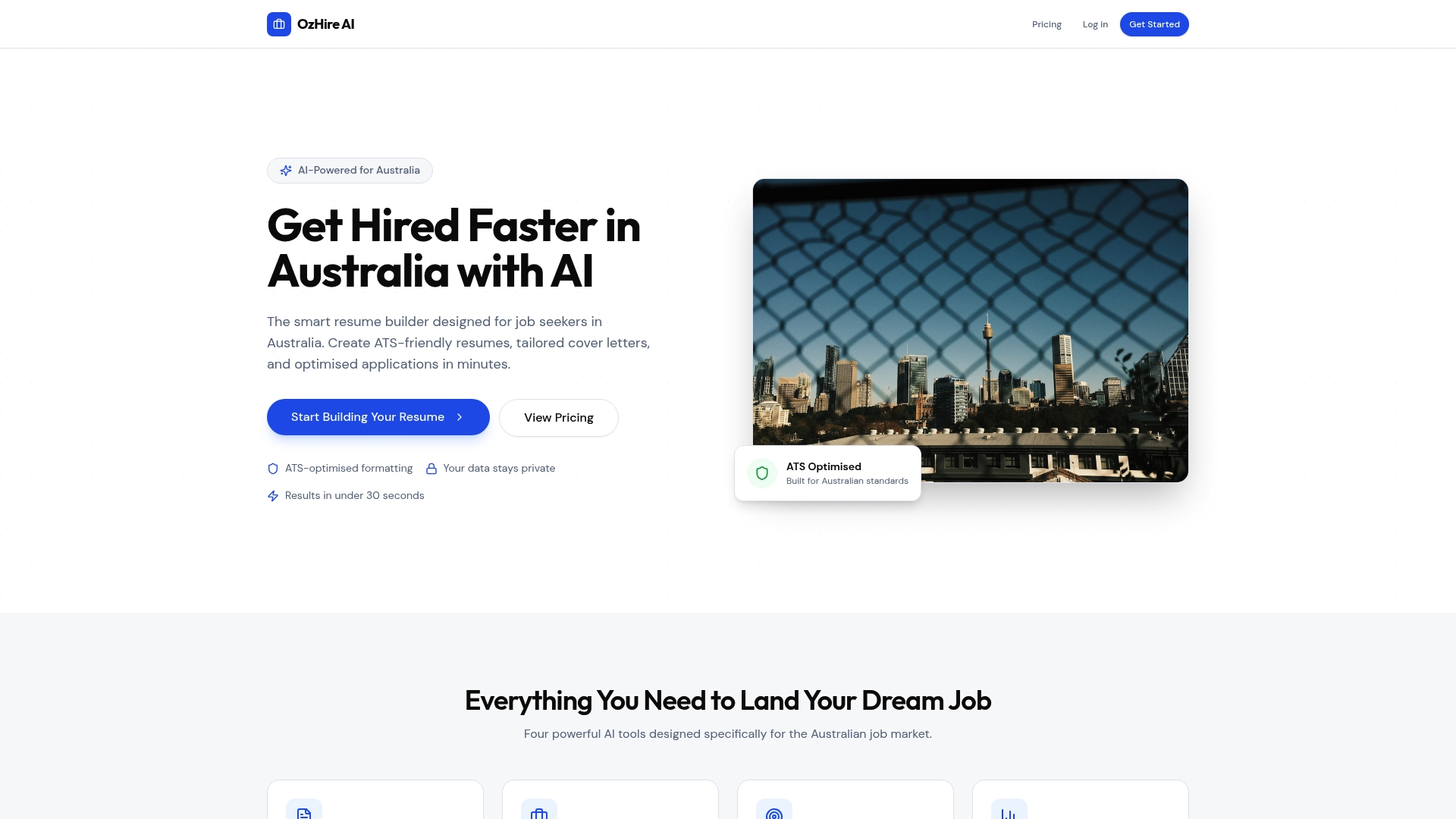
OzHire AI was built specifically for the Australian market, with tools that cover the full spectrum of recruiter productivity needs. From AI-powered resume parsing and candidate triage to ATS-compatible document generation and real-time scoring, the platform is designed to reduce manual effort and improve the quality of every application that moves through your pipeline. Australian compliance and data privacy are built in from the ground up, so you can automate with confidence. Whether you're running a boutique agency or scaling a high-volume operation, OzHire AI gives you the measurable results that justify every dollar of investment.
Frequently asked questions
What recruiter tasks can AI automate most efficiently?
AI best automates job post creation, resume data extraction, candidate filtering, and initial outreach communications. Research confirms that AI automates repeatable workflows including sourcing support, interview kits, and screening steps inside an ATS.
Does AI always reduce recruiter workload, or can it add complexity?
AI can sometimes increase workload by attracting more low-quality applicants or requiring extra checks for duplicates and fraud. Studies show that AI increases application volume and noise, requiring more structure, oversight, and identity verification.
How can Australian agencies prove ROI on a new AI recruiting tool?
Run a controlled 90-day pilot, baseline core metrics, and measure time saved in relation to hires made and cost per hire. The most reliable method is to run a controlled pilot with a defensible baseline and quantify time saved as outcome impact.
What's the biggest risk with AI productivity tools for recruiters?
Overreliance on automation can lead to decreased result quality if human oversight and pipeline discipline are lost. Research shows that AI adoption can backfire operationally when both sides optimize for AI, creating a doom loop that slows hiring and reduces signal quality.